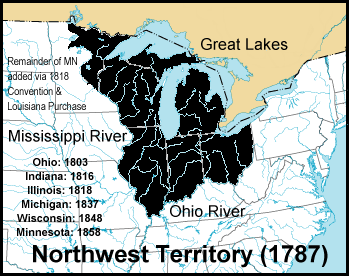
Despite its many weaknesses, the Confederation accomplished a mighty feat with the Northwest Ordinance. Passed July 13, 1787, this act both delineated a system of government for the Northwest Territory and established how states become a part of America. Previous legislation, the Territorial Ordinance of 1784 and the Land Ordinance of 1785, and attempts by Thomas Jefferson and Manasseh Cutler had gone awry in their attempts to take on this task of divvying up the land in this territory. However, at the Constitutional Convention in Philadelphia, the Confederation finally passed the ordinance that would solve many of the problems these previous endeavors had faced. Firstly, instead of the rough crowd that was formerly allowed to hold public office in the regions of the Northwest Territory, a governor (who wielded considerable power), secretary, and three judges were assigned by Congress. Then, once the region's population reached five thousand, property-owning men could elect an assembly; however, the governor possessed absolute veto. Finally, at the population of sixty thousand, a region could apply for full statehood. The constitutions of the territory included a bill of rights and outlawed slavery, but they did not require state-funded public education.
Divine, Robert A., T. H. Breen, George M. Fredrickson, and R. Hal Williams. America Past and Present. Revised Sixth Edition, AP* Edition . Addison-Wesley Educational Publishers Inc., 2003. 173-74. Print.
"Northwest Ordinance", Ohio History Central, July 1, 2005, http://www.ohiohistorycentral.org/entry.php?rec=1747
"IHB: Northwest Ordinance of 1787." IN.gov: Home. N.p., n.d. Web. 1 May 2011. <http://www.in.gov/history/2695.htm>.
Web. 1 May 2011. <http://static.newworldencyclopedia.org/9/9e/Northwest-territory-usa-1787.png>.
Sunday, May 1, 2011
Articles of Confederation
In addition to creating the Declaration of Independence, the Second Continental Congress established a committee, headed by Letters from a Farmer in Pennsylvania author John Dickinson, whose responsibility was to plan out this newborn nation's system of government. Dickinson's idea of a strong central government appalled delegates on July 12, 1776 and consequently was given a major renovation before it was approved by Congress November 5, 1777. The Articles of Confederation allowed for a one-house legislature with one vote from each state. There was no single executive body with no power to veto the legislature's decisions. Taxation was not allowed, which caused wartime difficulties. An amendment was only allowed if a unanimous vote by the states passed it through. This weak government was ratified with much dissent on March 1, 1781 and lasted only six years before our Founding Fathers began to overhaul the ineffective Articles of Confederation.
John Dickinson
Divine, Robert A., T. H. Breen, George M. Fredrickson, and R. Hal Williams. America Past and Present. Revised Sixth Edition, AP* Edition . Addison-Wesley Educational Publishers Inc., 2003. 170-71. Print.
Web. 1 May 2011. <http://www.history.army.mil/books/revwar/ss/p083.jpg>.
Declaration of Independence
At the outset of the Second Continental Congress, which began May 1775, in Philadelphia, not all the delegates--and not all the colonists--were in favor of declaring independence from Great Britain. Indeed, even the delegates in favor of severing ties with the mother country were wary of doing it to hastily, thus isolating and displeasing the colonist public. While the Congress continued flip-flopping on this issue, two important pushes toward independence occurred. First, in December 1775, the British Parliament passed the Prohibitory Act, which blockaded the colonies' ports and allowed for the seizure of American ships. Further riling up the colonists was Thomas Paine's Common Sense. This pamphlet defamed King George III as a "royal brute" and put into question the entire concept monarchical rule. More importantly, Paine made the point that it was not "common sense" to continue under British rule, and with this he stressed immediate revolution, stating that "the birthday of a new world is at hand." On July 2, 1776, the Congress voted for independence. Two days later, Thomas Jefferson's written declaration was accepted. The Declaration included a list of objections to King George III, but more importantly, it challenged all Americans to partake in democracy ad liberty.

Divine, Robert A., T. H. Breen, George M. Fredrickson, and R. Hal Williams. America Past and Present. Revised Sixth Edition, AP* Edition . Addison-Wesley Educational Publishers Inc., 2003. 146-8. Print.
"Declaration of Independence." Web. 1 May 2011. <http://upload.wikimedia.org/wikipedia/commons/thumb/1/15/Declaration_independence.jpg/600px-Declaration_independence.jpg>.
Divine, Robert A., T. H. Breen, George M. Fredrickson, and R. Hal Williams. America Past and Present. Revised Sixth Edition, AP* Edition . Addison-Wesley Educational Publishers Inc., 2003. 146-8. Print.
"Declaration of Independence." Web. 1 May 2011. <http://upload.wikimedia.org/wikipedia/commons/thumb/1/15/Declaration_independence.jpg/600px-Declaration_independence.jpg>.
Thursday, April 28, 2011
The Truman Doctrine
Harry S. Truman's key method for dealing with Soviet and communistic influences was the policy of containment--the brainchild of Secretary of State George C. Marshall, undersecretary of state Dean Acheson, and Soviet expert George Kennan. Kennan, in an article for Foreign Affairs, wrote that nothing short of "long-term, patient but firm and vigilant containment of Russian expansive tendencies" could stem the tide of the communism across the globe. Truman put words into action with the Truman Doctrine.
One such victim of communist influence was Greece. Since March of 1946, Great Britain had been bolstering Greece's government against a communist insurrection. By the next February, the British government could no longer support Greece, informing the United States of this. Great Britain was also withdrawing financial aid from Turkey, where Soviets were demanding access to the Dardanelles. Citing his domino theory, Acheson said that should Turkey and Greece fall to communism, so too would nations as far east as India. On March 12, 1847, President Truman requested $400 million to aid these two countries to prevent "subjugation by armed minorities or by outside pressures." This doctrine has often been cited as the beginning of the Cold War.
President Truman and Dean Acheson
Divine, Robert A., T. H. Breen, George M. Fredrickson, and R. Hal Williams. America Past and Present. Revised Sixth Edition, AP* Edition . Addison-Wesley Educational Publishers Inc., 2003. 825-6. Print.
President Truman's Message to Congress; March 12, 1947; Document 171; 80th Congress, 1st Session; Records of the United States House of Representatives; Record Group 233; National Archives.
Newman, John J., and John M. Schmalbach. United States History: Preparing for the Advanced Placement Examination. Revised. New York, NY: Amsco School Publications, Inc., 551-52. Print.
"Pres. Harry S. Truman Talking to Dean Acheson." Web. 28 Apr 2011. <http://imagecache6.allposters.com/LRG/37/3790/OBEIF00Z.jpg>.
Wednesday, April 27, 2011
Lend-Lease Act
The depressing and disillusioning outcome of World War I, the isolationism of the 1920s, and the struggle of overcoming the worldwide economic depression all led to American resistance to involvement in the Second World War. Franklin D. Roosevelt, the president who helped lead Americans out of the Great Depression, however, disagreed with Congress and the general public and sought to revise previously enacted neutrality legislation by instead allowing cash-and-carry trade with belligerents. As German forces continued beating down on the Allies, Roosevelt gained further ground on the road toward war with such initiatives as the policy of allowing all-out aid to the Allies and the Destroyer Deal. Eventually, the public came to agree with the interventionists--the opponents of isolationists who wanted to help the Allies so as to protect American security. This change of opinion spurred Roosevelt to attempt to truly make American the "arsenal of democracy."
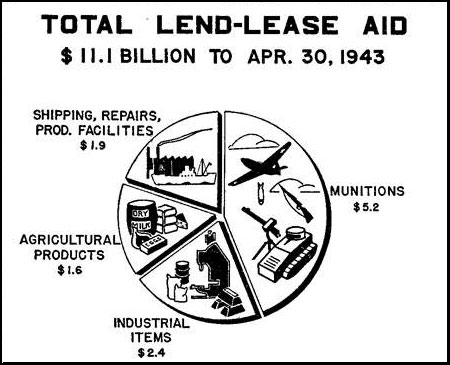
Roosevelt proposed this action January 1941. The act delineated that the United States would lend and lease "defense article[s]" to the "government of any country whose defense the President deems vital to the defense of the United States." This plan also included an appropriation of $7 billion dollars, effectively eliminating any financial obstacles Great Britain might have faced in accessing the American arsenal. After this piece of legislation, America was just short of entering the war themselves, and the Allies would have to wait until later that year--after the bombing of Pearl Harbor--to receive assistance in combat from the United States.
Divine, Robert A., T. H. Breen, George M. Fredrickson, and R. Hal Williams. America Past and Present. Revised Sixth Edition, AP* Edition . Addison-Wesley Educational Publishers Inc., 2003. 798-9. Print.
Lend Lease Bill, dated January 10, 1941. Records of the U.S. House of Representatives, HR 77A-D13, Record Group 233, National Archives.
"Total Lend-Lease Aid to April 30, 1943." Web. 27 Apr 2011. <http://www.ibiblio.org/hyperwar/USA/ref/LL-AllForOne/img/LL-AllForOne-p5.jpg>.
Roosevelt proposed this action January 1941. The act delineated that the United States would lend and lease "defense article[s]" to the "government of any country whose defense the President deems vital to the defense of the United States." This plan also included an appropriation of $7 billion dollars, effectively eliminating any financial obstacles Great Britain might have faced in accessing the American arsenal. After this piece of legislation, America was just short of entering the war themselves, and the Allies would have to wait until later that year--after the bombing of Pearl Harbor--to receive assistance in combat from the United States.
Divine, Robert A., T. H. Breen, George M. Fredrickson, and R. Hal Williams. America Past and Present. Revised Sixth Edition, AP* Edition . Addison-Wesley Educational Publishers Inc., 2003. 798-9. Print.
Lend Lease Bill, dated January 10, 1941. Records of the U.S. House of Representatives, HR 77A-D13, Record Group 233, National Archives.
"Total Lend-Lease Aid to April 30, 1943." Web. 27 Apr 2011. <http://www.ibiblio.org/hyperwar/USA/ref/LL-AllForOne/img/LL-AllForOne-p5.jpg>.
Subscribe to:
Posts (Atom)