Showing posts with label Henry Clay. Show all posts

Saturday, October 16, 2010

Compromise of 1850

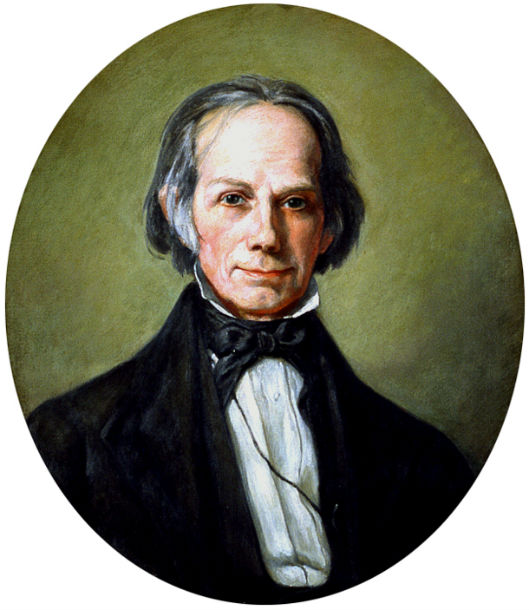
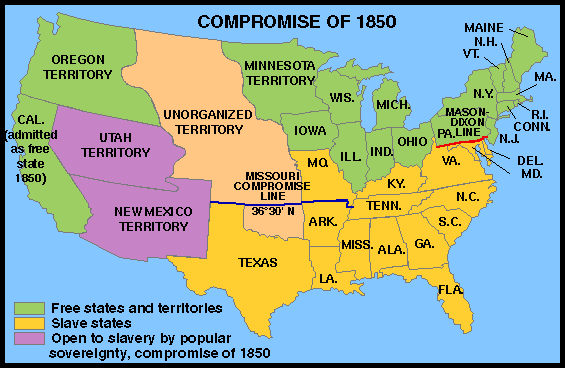
Once more, the Great Compromiser Henry Clay took it upon himself to help solve the sectional crisis the United States was experiencing in the first half of the eighteenth century. When California requested to enter the nation as a free state in 1849, Southerners cried foul at this potential disturbance of the careful balance between slave-owning and free states. The Compromise of 1850, as a series of five pieces of legislation, helped to keep the North and South at bay, delaying the onset of war.

In addition to allowing California into the country as a free state, Clay proposed establishing territorial governments in the Utah and New Mexico territories--territory gained from the Mexican cession--on the basis of popular sovereignty. Also, the Compromise settled the boundary dispute between Mexico and Texas. A newly-edited, harsher and more severe Fugitive Slave Law was enacted. While these concessions were made to the South, the Compromise prohibited the slave trade in Washington, DC as a concession to the North.

Most Democrats supported the bill, as did southern Whigs. It was opposed, though, by President Zachary Taylor; however, Taylor died and Millard Fillmore, his successor, was in favor of the Compromise. The general success of the Compromise and the near-consensus along party lines eased sectional tensions in the United States for a time.


Divine, Robert A., T. H. Breen, George M. Fredrickson, and R. Hal Williams. America Past and Present. Revised Sixth Edition, AP* Edition . Addison-Wesley Educational Publishers Inc., 2003. 395-97. Print.
"Our Documents - Compromise of 1850 (1850)." Our Documents - Home. N.p., n.d. Web. 16 Oct 2010. < http://www.ourdocuments.gov/doc.php?flash=true&doc=27 >
Compromise of 1850 and Popular Sovereignty Map. Web. 16 Oct 2010. < http://thomaslegion.net/thecompromiseof1850andpopularsovereigntymap.html >.

Wednesday, October 13, 2010

Jackson's Force Bill and the Nullification Crisis

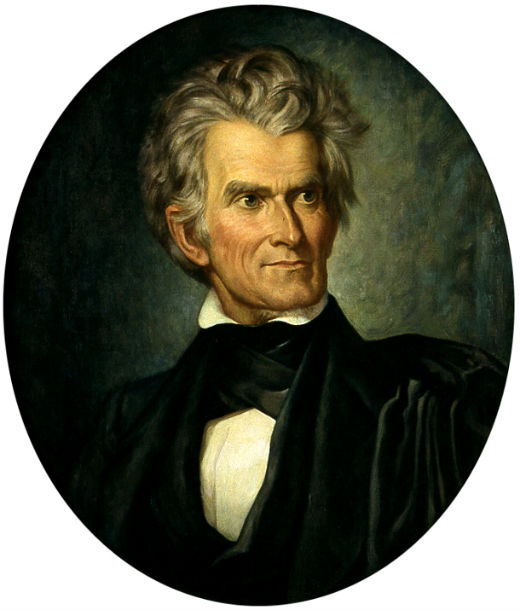
Disagreeing viewpoints on states' rights began as early as the 1820s when South Carolina found the ever-rising protective tariff offensive to the South, whose economy was based on agriculture and who had to pay higher prices for manufactured goods because of this. South Carolina, coordinated by Vice President and strong states' rights supporter John C. Calhoun, disagreed with the tariff of abominations of 1828, deemed the tariff unconstitutional, and nullified it.

John C. Calhoun

Calhoun's outright defiance of national power caused a rift between himself and President Jackson. Jackson, although a supporter of southern interests and states' rights, rightly saw that nullification had the potential to damage the Union. After the state legislature of South Carolina convened to vote to nullify the tariffs of 1828 and 1832, Jackson decided to take action.

At Jackson's request, Congress passed the Force Bill that allowed Jackson to use military force to ensure that South Carolina would adhere to the tariff. The Great Compromiser Henry Clay once again used his superior compromising abilities to get Jackson to pass a lower tariff. The Force Bill and the compromise of 1833 both resulted in South Carolina abolishing their nullification efforts in March of the same year. This assertion of states' rights was reiterated as South Carolina seceded from the Union over a quarter of a century later.


Divine, Robert A., T. H. Breen, George M. Fredrickson, and R. Hal Williams. America Past and Present. Revised Sixth Edition, AP* Edition . Addison-Wesley Educational Publishers Inc., 2003. 295-96. Print.

Web. 13 Oct 2010. <http://www.senate.gov/artandhistory/art/common/image/Painting_32_00009.htm>.

Monday, October 11, 2010

The Missouri Compromise


The prospective admittance of Missouri as a slave state opened the question of how slavery was going to be treated in the unorganized Louisiana territory. At this time, many Northerners were upset with the South's dominance in House of Representation due to the Three-Fifths compromise and thought the South had control over the presidency, and when Missouri was proposed to enter the nation as a slave state, the North was upset at this inequality. While New York Congressman James Tallmadge proposed to allow slavery in Missouri but abolish it over time, this was voted down in the Senate and the matter remained unsolved.

Meanwhile, Maine was seeking to separate from Massachusetts and enter into statehood. The Senate voted to enter Maine as free state along with Missouri as a slave state February 1820. Henry Clay helped to establish the latitude 36°30' as the compromise line, where all the unorganized territory above it was banned from instituting slavery and the territory below was permitted to establish slavery.


Henry Clay established himself as the Great Compromiser, and while the United States avoided this sectional dispute, this set the course of North-versus-South altercations for decades to come, culminating in the Civil War. The Missouri Compromise line was later to be negated by the Kansas-Nebraska Act, which only expanded the rift already present in the nation.

Divine, Robert A., T. H. Breen, George M. Fredrickson, and R. Hal Williams. America Past and Present. Revised Sixth Edition, AP* Edition . Addison-Wesley Educational Publishers Inc., 2003. 273-74. Print.

Web. 11 Oct 2010. <http://www.senate.gov/artandhistory/art/common/image/Painting_32_00007.htm>.