Showing posts with label Missouri Compromise. Show all posts

Sunday, October 17, 2010

Kansas-Nebraska Act

Tensions were to reach a new high when Illinois Senator Stephen A. Douglas proposed to organize the Kansas and Nebraska territories on the basis of popular sovereignty. He did so to appeal to the Southerners while the Northerners were outraged because this would repeal the line set by the Missouri Compromise.

Douglas proposed this bill largely out of personal interest. He wanted to open up the territory to railway expansion and make available land for settlement and trade. Also, as a Democrat, he thought this spirit of expansion would revive and unite the Democratic party, who had earlier in the century been under the banner of Manifest Destiny. All this, he hoped, would eventually gain him the presidency. However, while the bill was passed in both the Senate and the House, half of the northern Democrats voted against the bill, and Douglas' bill destroyed any sectional consensus left. Other political side effects were the dissolution of the Whigs and the eventual creation of the Republican Party.

Stephen A. Douglas


Divine, Robert A., T. H. Breen, George M. Fredrickson, and R. Hal Williams. America Past and Present. Revised Sixth Edition, AP* Edition . Addison-Wesley Educational Publishers Inc., 2003. 398-99. Print.

Web. 17 Oct 2010. < http://www.kshs.org/research/topics/politics/graphics/douglas_stephen.jpg >.

Monday, October 11, 2010

The Missouri Compromise


The prospective admittance of Missouri as a slave state opened the question of how slavery was going to be treated in the unorganized Louisiana territory. At this time, many Northerners were upset with the South's dominance in House of Representation due to the Three-Fifths compromise and thought the South had control over the presidency, and when Missouri was proposed to enter the nation as a slave state, the North was upset at this inequality. While New York Congressman James Tallmadge proposed to allow slavery in Missouri but abolish it over time, this was voted down in the Senate and the matter remained unsolved.

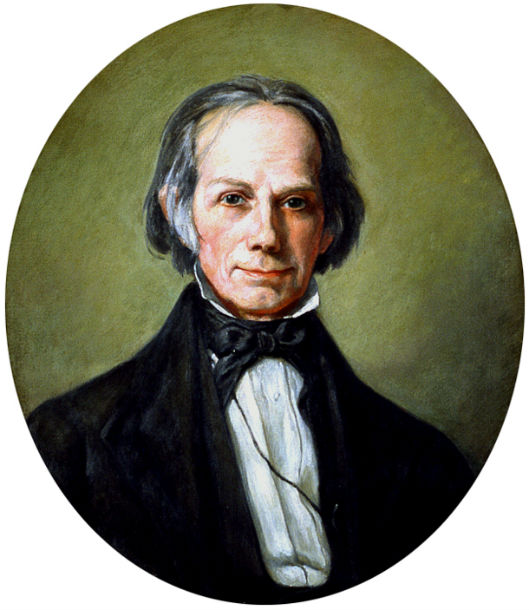
Meanwhile, Maine was seeking to separate from Massachusetts and enter into statehood. The Senate voted to enter Maine as free state along with Missouri as a slave state February 1820. Henry Clay helped to establish the latitude 36°30' as the compromise line, where all the unorganized territory above it was banned from instituting slavery and the territory below was permitted to establish slavery.


Henry Clay established himself as the Great Compromiser, and while the United States avoided this sectional dispute, this set the course of North-versus-South altercations for decades to come, culminating in the Civil War. The Missouri Compromise line was later to be negated by the Kansas-Nebraska Act, which only expanded the rift already present in the nation.

Divine, Robert A., T. H. Breen, George M. Fredrickson, and R. Hal Williams. America Past and Present. Revised Sixth Edition, AP* Edition . Addison-Wesley Educational Publishers Inc., 2003. 273-74. Print.

Web. 11 Oct 2010. <http://www.senate.gov/artandhistory/art/common/image/Painting_32_00007.htm>.